
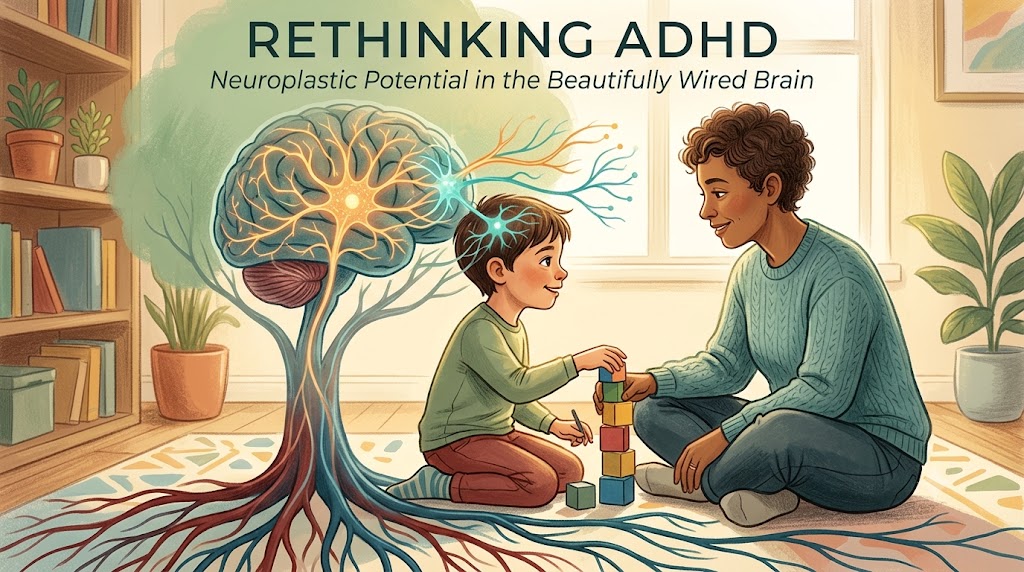
How current neuroscience — and Dr. Stanley Greenspan’s Developmental, thinking-based framework — invite us to see the ADHD child not as broken, but as beautifully wired, and wired to grow.
Introduction: Two Words That Do Not Belong Together — Until They Do
For decades, ADHD has been described almost exclusively in the language of deficit. The very acronym begins with a subtraction sign: Attention-Deficit / Hyperactivity Disorder. Missing. Broken. Absent. Too much. Too little. The narrative most parents inherit from the first pediatric visit is that something is wrong with their child’s brain and that the goal of intervention is to compensate for what is not there.
But two of the most important movements in child development over the past twenty years have quietly rewritten that story. The first is the neurodivergence movement, which reframes conditions like ADHD, autism, and dyslexia as natural variations in the human brain rather than diseases to be cured. The second is the explosion of neuroplasticity research, which has revealed that the brain — especially the developing child’s brain — is capable of remarkable, lifelong growth and strenghting in response to experience, relationship, and challenge.
When these two ideas meet, something powerful happens. We stop asking, “How do we fix this child?” and start asking, “How do we understand this specific child’s nervous system, and how do we build the kind of experiences that will let their unique brain grow into its full capacity?” That question — asked one child at a time — is the question Dr. Stanley Greenspan built his entire career around. It is the question the Greenspan/DIR™ Model was designed to answer. And it is the question this article is written to explore, with ADHD as our lens.
The ADHD brain is not a broken brain. It is a differently-wired brain that is also, by virtue of being a developing brain, extraordinarily capable of growth/change — provided we meet it with meaningful relationships and the ”just right” kind of experiences.
Part One: What ADHD Actually Is — The Neurodivergent Perspective
Modern neuroscience paints a picture of ADHD that looks nothing like the old “willful, lazy, or undisciplined child” stereotype. Contemporary brain imaging studies show that children with ADHD have measurably different patterns of cortical maturation — most notably a delay of two to five years in the development of the prefrontal cortex, the brain region responsible for executive functioning, impulse control, and attentional regulation (Shaw et al., 2007; Shaw et al., 2013). This is not a permanent structural deficit. It is a differently timed developmental trajectory.
The ADHD brain also shows distinct differences in its dopamine and norepinephrine systems — the neurochemical messengers most responsible for reward, motivation, and sustained attention (Volkow et al., 2009). The default mode network (the brain’s “resting” or self-referential system) and the task-positive network (the brain’s “focus” system) do not switch as cleanly in ADHD brains as they do in neurotypical ones (Sonuga-Barke & Castellanos, 2007). This is why a child with ADHD can hyperfocus for three hours on something they find genuinely interesting and cannot sustain three minutes on something they find neutral — the switching mechanism itself is calibrated differently.
The neurodivergent reframe
The neurodivergence movement invites us to see these differences the same way we see left-handedness or introversion — as variations, not defects. The ADHD brain often excels at:
- Divergent thinking and creative problem-solving
- Rapid pattern recognition and idea association
- Hyperfocus on high-interest topics (a form of attentional intensity, not attentional absence)
- Novelty-seeking and adaptive risk-taking
- Emotional intensity and empathic responsiveness
These are not consolation-prize “superpowers.” They are cognitive and emotional capacities that neurotypical brains do not always match, and they are inseparable from the same wiring that makes sustained attention on low-interest tasks so difficult. You cannot subtract the challenges without subtracting the strengths — they are the same brain.
But — and this is critical — accepting neurodivergence does not mean accepting suffering. A child who is failing school, losing friends, and internalizing shame is a child who needs support. The neurodivergent frame is not “do nothing.” It is “do the right thing, for this child, based on how this child’s nervous system actually works.” That right thing, more often than not, is not what the child is currently getting.
Part Two: The Amygdala–Prefrontal Cortex Story in ADHD
In our earlier article “What Your Child’s Behavior Is Trying to Tell You”, we walked through the biologically accurate sequence of how the child’s brain actually processes the world. We showed that human perception and behavior do not begin at the top with logical thinking. They begin at the bottom, with sensory data and emotional appraisal, and only then — if the child feels safe enough — do they climb up to the prefrontal cortex where thinking, planning, and self-control live.
That sequence is worth restating because it is the heart of why so many ADHD interventions fail:
- Sensory Perception (the body) — the child’s nervous system registers input
- Emotional Perception (the amygdala) — the input is instantly appraised as safe, threatening, exciting, or overwhelming
- Behavior (the action) — the body responds automatically: fight, flight, freeze, or engage
- Thought (the prefrontal cortex) — logic and reflection come online ONLY after the child is regulated again, not simply calm.
For the ADHD child, this bottom-up architecture is running on hardware that is particularly sensitive to the balance between the amygdala (the alarm) and the prefrontal cortex (the brake). Arnsten’s landmark 2009 review demonstrated that under stress — or in a state of chronic low-grade dysregulation — the prefrontal cortex essentially goes offline while the amygdala takes over (Arnsten, 2009). For a child whose PFC is already developing two to five years behind their same-age peers, this shutdown happens faster, lasts longer, and is triggered by smaller stressors than it would be in a neurotypical peer.
This is why the classic classroom scene plays out the way it does. The teacher asks the child with ADHD to “just focus” or “just think before you act.” The child genuinely wants to comply. But the request is being sent to a prefrontal cortex that has already been overwhelmed by sensory input, social pressure, and emotional flooding. The brain region being asked to do the thinking is not currently in the room. Expecting logic from a brain in that state is, as we said in the earlier piece, “biologically impossible.”
You cannot reason a child out of a state their prefrontal cortex is not in.
What co-regulation does that reward charts cannot
Research using fMRI has shown that when a child experiences co-regulation with a warm, attuned adult, activity in the prefrontal cortex increases in conjunction with decreased amygdala reactivity to negative stimuli — a measurable neural signature of improved emotion regulation (Guyer et al., 2015; Kanske et al., 2011). This is not a metaphor. The presence of a calm, connected caregiver literally rewires the ADHD child’s stress response over time by giving the developing PFC repeated practice at coming back online with support. Reward charts do not do this. Time-outs do not do this. Only relationships do.
Part Three: Neuroplasticity — Why the ADHD Brain Is Built to Strengthen (Change)
The single most important scientific insight of the last thirty years for parents of children with ADHD may be this: the brain you were told your child “has” is not the brain your child will keep. Neuroplasticity — the brain’s ability to physically reorganize itself in response to experience — is the biological reality that makes every developmental intervention possible in the first place.
In our article The Death Spiral of Learning: Why Positive Reinforcement May Be Holding Us Back, we explored a groundbreaking 2024 study from Northwestern University published in Communications Physics. The researchers showed that Donald Hebb’s famous principle — “neurons that fire together, wire together” — has a hidden dark side. When the same neural pathways are repeatedly reinforced through predictable, adult-directed rewards, the brain does not just get better at that one path. It gets stuck on that one path. It carves what the researchers likened to a scratched vinyl record — a deep groove the needle cannot escape.
That research has profound implications for ADHD. If the ADHD brain is naturally more novelty-seeking, more divergent, and more prone to wide-ranging exploration than its neurotypical peers, then a heavily reinforced, adult-directed, reward-based intervention may be actively working against the very neural wiring that makes the child who they are. It doesn’t just fail to help — it can make the child more rigid, more prompt-dependent, and more disconnected from their own internal motivation.
What neuroplasticity actually is (and why it favors relational intervention)
Neuroplasticity is not a single mechanism. It is a family of processes that includes:
- Synaptic plasticity — strengthening or weakening of individual connections between neurons
- Structural plasticity — the physical growth of new dendrites, axons, and even new neurons in some regions (like the hippocampus)
- Functional plasticity — the reassignment of brain functions from damaged or underdeveloped regions to healthy ones
- Myelination — the insulation of frequently-used neural pathways so signals travel faster and more reliably
All four of these processes are driven by experience. And not just any experience — the neuroscience of the past two decades has been remarkably consistent about what kind of experience drives the most robust, generalizable change: novel, effortful, emotionally engaged, socially embedded experience (Doidge, 2007; Merzenich, 2013). That description reads almost like a verbatim job description for Dr. Greenspan’s Floortime. It does not read like a description of a token economy.
The ADHD brain is not merely capable of change. It is neurologically primed for change — provided the change is driven by relationship, curiosity, and manageable challenge, not by external reward alone.
The specific evidence in ADHD
Halperin and Schulz’s influential 2006 paper reframed ADHD as, in significant part, a “delayed maturation” phenomenon rather than a fixed disorder — and they argued that this reframe opens the door to interventions that promote neuroplastic maturation of the prefrontal cortex, rather than merely medicating around it (Halperin & Schulz, 2006). Follow-up research on cortical thickness trajectories has repeatedly shown that many children with ADHD experience partial or complete “catch-up” in PFC development over adolescence — evidence that the brain does close the gap when given time and the right experiences (Shaw et al., 2013).
Diamond and Lee’s 2011 review in Science, which we cited in our Executive Functioning piece, identified the most effective evidence-based executive-function interventions for children aged 4 to 12. The list is striking:
- Play-based, relationship-centered interventions (aligned with Greenspan Floortime®)
- Aerobics, yoga, and martial arts
- Mindfulness practices
- Child-centered occupational therapy
- Unstructured, socially interactive play with caregivers and peers
Not on the list: reward charts. Not on the list: worksheets. Not on the list: rigid compliance-based behavioral programs. The interventions with the strongest evidence for actually rewiring the developing brain are the ones that most closely resemble what children — especially children with ADHD — are naturally trying to do.
Part Four: The “Who Is Doing the Thinking?” Trap — Especially Dangerous in ADHD
Dr. Greenspan famously asked, in his Floortime consultations, one deceptively simple question: “Who is doing the thinking?” It is a question that lands with particular force in the context of ADHD, because the child with ADHD is so often the one whose environment does the most thinking for them.
Consider a typical school day for a child with ADHD in a behavior-management-heavy setting. The morning schedule is on a laminated card. The transitions are announced. The reward for on-task behavior is spelled out on a token board. The next step is prompted. The correct answer is modeled. Every executive function the child is supposed to be developing — planning, sequencing, holding a goal in working memory, inhibiting an impulse — is being performed BY THE ADULT, in real time, on the child’s behalf.
The child is not building the muscle. The adult is lifting the weight for them.
In the short term, this looks like progress — the child completed the task, checked the box, earned the sticker. In the long term, it produces what our article on rigid thinking called the “Death Spiral”: a child whose brain has been trained to wait for the next prompt rather than generate the next idea. For a child whose neurotype is already naturally exploratory, this is a particular kind of tragedy. We are taking a brain that was built to leap between ideas and training it to stand still until the next signal.
Coelho et al. 2015: the study nobody quotes
One of the most instructive pieces of research in this space is a 2015 study by Coelho and colleagues in Frontiers in Psychiatry, which specifically examined the use of cognitive behavioral therapy and token economies for children with ADHD. The finding that rarely gets quoted in the ADHD-treatment literature: children whose behavioral struggles are rooted in deep emotional regulation issues or in a lack of self-monitoring capacity — a description that fits a large subset of ADHD children — often demonstrate strict resistance and even behavioral deterioration under rigid reward-and-consequence systems (Coelho et al., 2015).
In plain English: the very children the token economy is designed for are often the children it makes worse. This finding echoes what many parents already know from lived experience — the sticker chart worked for two weeks, then stopped, then made everything louder. It is not because the child was manipulating the system. It is because the system was aimed at the wrong developmental layer.
Part Five: The “I” in DIR — Why Every ADHD Child Needs Their Own Map
The middle letter of the Greenspan/DIR™ Model is the letter that changes everything. The “I” (or the “Roots” of The Learning Tree) represents Individual Differences. Before you can help any child, Dr. Greenspan insisted, you must first understand THIS child. Not ADHD as a category. Not children with ADHD as a group. This specific child, with this specific nervous system, in this specific family, at this specific developmental moment.
For ADHD, this insistence is not academic. ADHD is one of the most heterogeneous diagnostic labels in child psychiatry. Two children can both meet full criteria for ADHD-Combined Type and have almost nothing in common at the level that actually matters — the level of how they process the world:
- One child may be sensory-seeking (crashes into furniture, craves deep pressure) while another is sensory-avoiding (covers ears at typical classroom noise)
- One child may have strong auditory processing but weak visual-motor integration; the other, the reverse
- One child may go into shutdown under stress; the other into meltdown
- One child may have a co-occurring language processing difference that a symptom checklist will completely miss
- One child may be regulated by movement; the other may be dysregulated by it
A one-size-fits-all ADHD protocol — whether pharmacological, behavioral, or educational — treats these children as if they are the same. Individual Differences insists they are not, and that our intervention must start with mapping THIS child’s roots before we touch a single leaf.
The Learning Tree, applied to ADHD
Dr. Greenspan’s Learning Tree gives us the mapping tool. The roots of the tree are the child’s regulatory system (sensory-motor and emotional)— how the nervous system takes in and organizes the world. The trunk is the child’s functional emotional developmental milestones — shared attention, engagement, two-way communication, social problem-solving and the continuous flow of interaction, meaningful symbolic ideation, and logical thinking. The branches are the observable skills — school performance, friendships, self-care, communication. The leaves are the behaviors we see, including the ones that got the ADHD label attached in the first place.
When we treat ADHD from a leaves-only perspective, we medicate the symptom, chart the behavior, and hope the child cooperates. When we treat ADHD from a whole-tree perspective, we ask:
- What does this child’s sensory/emotional regulatory root system actually need? (Under-stimulation? Deep pressure? Rhythm? Quiet? Control? Empathy?)
- Which functional emotional developmental milestones are strong, and which need scaffolding?
- Where in the daily interactive loop is this child getting rich, thinking-driven, co-regulated experience — and where are they simply being managed?
- What are the adults around this child (parents, teachers, therapists) bringing to the interaction that might be feeding either the roots or the storm?
This last question is the one Dr. Greenspan considered most important, and it is the one traditional ADHD protocols almost never ask. In our behavior article we noted that “a child’s tree grows directly out of the emotional and sensory soil provided by their parents, teachers, and therapists.” For the ADHD child, whose nervous system is more sensitive to the emotional tone of the room than most, the adults’ regulation is not background. It is the intervention.
Part Six: What Greenspan Floortime® Actually Looks Like for the ADHD Child
The Greenspan Floortime Approach® — Dr. Greenspan’s version of DIR/Floortime — is often introduced to families as an autism intervention. It is one, and a well-evidenced one. But it was never designed exclusively for autism. It was designed for children — any child whose developmental trajectory needs a relationally-embedded, developmentally-informed, individually-tailored approach. For the child with ADHD, that description fits precisely.
What changes when you Floortime an ADHD child
Following the child’s lead. The ADHD child’s attention gravitates toward what is genuinely interesting. Rather than treating this as a problem to be extinguished, Floortime treats it as a doorway. When the adult joins the child inside their genuine interest — whether that is trains, dinosaurs, a particular game, or a peculiar way of arranging blocks — the child’s emotional engagement climbs, and with it, sustained attention, working memory, and reciprocal communication.
Opening and closing many circles of communication. The ADHD child’s difficulty is not usually opening circles (they open plenty!) but closing them — following a thread of back-and-forth to its natural conclusion. Floortime deliberately creates dozens of small conversational loops per session, giving the developing PFC real, repeated practice at holding a thread and completing it.
Manageable challenge, not adult-imposed challenge. Dr. Greenspan called this the “just-right” challenge. A puzzle piece placed slightly out of reach so the child has to point. A pretend-play obstacle that requires one more idea from them. A silly misunderstanding that requires them to correct you. Each small challenge activates the executive functioning system in a low-stakes, high-engagement context — which is exactly the neurological condition under which the ADHD brain does its best plasticity work.
Co-regulation before cognition. Every Floortime interaction begins with the adult settling their own nervous system so the child has a calm anchor to borrow from. For the ADHD child, whose amygdala can hijack their PFC at speeds neurotypical adults underestimate, this borrowed calm is the single most direct way to build the child’s own regulatory capacity over time.
Process over product. The point is never the finished puzzle, the completed worksheet, or the compliant answer. The point is that the child DID the thinking, GENERATED the idea, and NAVIGATED the moment. That is the reps that build the muscle. That is the experience that drives neuroplastic change.
If we want the ADHD brain to grow into its full capacity, we have to stop outsourcing its executive functioning to reward systems and start inviting it to do its own thinking, inside relationships that make it safe to try.
Part Seven: Practical Guidance for Parents and Clinicians
For parents
- Start with the roots, not the leaves. Before you address the behavior, ask what your child’s sensory and regulatory system might be telling you. What did the morning look like? What was the last transition? Where in the day did the dysregulation actually begin?
- Study your own tree. Dr. Greenspan asked adults to map their own sensory and emotional roots too. Your child’s ADHD nervous system will trigger your own — notice what triggers you, and work on your own regulation so you can be the anchor.
- Trade at least one reward chart for one Floortime session per day. Twenty minutes on the floor, following your child’s lead, opening and closing circles, will build more executive functioning than any sticker.
- Protect free play. Unstructured, self-directed, socially interactive play is on every evidence-based EF intervention list. Guard it.
- Choose therapists who work relationally. When interviewing an OT, speech-language pathologist, or behavioral clinician, ask: “Do you follow the child’s lead? Do you work with the parent-child relationship, or with the child alone? How do you handle dysregulation — do you push through, or do you co-regulate?”
For clinicians and educators
- Assess with the Learning Tree, not just the diagnostic checklist. The DSM tells you what to call the child. The Learning Tree tells you what the child actually needs.
- Watch who is doing the thinking. In every intervention plan, ask whether the child is generating the response or executing an adult-generated script.
- Use scaffolding that fades. If prompts are still needed at week 12 in the same form they were at week 1, the intervention is not building capacity — it is building dependence.
- Track co-regulation as an outcome. Alongside behavior data, track adult-child affective synchrony, time-to-recovery after a dysregulation event, and the child’s reported sense of felt safety with each caregiver in their circle.
- Talk to families about neuroplasticity. Parents who understand that their child’s brain is capable of change respond differently to setbacks than parents who believe the diagnosis is a life sentence. This is not false hope. It is what the research actually shows.
Conclusion: A Different Story to Tell
The story we have told children with ADHD and their families for the past forty years has largely been a story of deficit — of what the brain lacks, of what needs to be managed, of behaviors that need to be corrected. The neuroscience of the past twenty years, and the developmental wisdom that Dr. Stanley Greenspan brought to his life’s work, invite us to tell a different story.
It is a story in which the ADHD brain is neurodivergent — genuinely, biologically wired differently — AND neurologically primed for change. It is a story in which the amygdala’s alarm and the prefrontal cortex’s brake can come into balance, not through willpower or compliance, but through thousands of small, co-regulated, thinking-driven moments with a warm, attuned adult. It is a story in which the child does the thinking, the adult holds the safety, and the brain — that beautifully plastic, endlessly adaptable brain — grows itself in the direction the child was always trying to go.
That story starts, always, with one child. This child. Mapped as an individual, met in their own developmental moment, engaged inside a relationship that makes it safe to keep trying. That is the story the Greenspan/DIR™ Model was built to tell. And it is a story worth telling — one child, one family, one moment on the floor at a time.
References & Further Reading
Arnsten, A. F. T. (2009). Stress signalling pathways that impair prefrontal cortex structure and function. Nature Reviews Neuroscience, 10(6), 410–422.
Coelho, L. F., Barbosa, D. L. F., Rizzutti, S., Muszkat, M., Bueno, O. F. A., & Miranda, M. C. (2015). Use of cognitive behavioral therapy and token economy to alleviate dysfunctional behavior in children with attention-deficit hyperactivity disorder. Frontiers in Psychiatry, 6, 167.
Diamond, A. (2013). Executive functions. Annual Review of Psychology, 64, 135–168.
Diamond, A., & Lee, K. (2011). Interventions shown to aid executive function development in children 4 to 12 years old. Science, 333(6045), 959–964.
Doidge, N. (2007). The Brain That Changes Itself: Stories of Personal Triumph from the Frontiers of Brain Science. Viking.
Greenspan, S. I., & Wieder, S. (2006). Engaging Autism: Using the Floortime Approach to Help Children Relate, Communicate, and Think. Da Capo Press.
Guyer, A. E., Silk, J. S., & Nelson, E. E. (2015). The neurobiology of the emotional adolescent: From the inside out. Neuroscience & Biobehavioral Reviews, 70, 74–85.
Halder, S., & Mahato, A. K. (2019). Cognitive behavior therapy for children and adolescents: Challenges and gaps in practice. Indian Journal of Psychological Medicine, 41(4), 279–283.
Halperin, J. M., & Schulz, K. P. (2006). Revisiting the role of the prefrontal cortex in the pathophysiology of attention-deficit/hyperactivity disorder. Psychological Bulletin, 132(4), 560–581.
Kanske, P., Heissler, J., Schönfelder, S., Bongers, A., & Wessa, M. (2011). How to regulate emotion? Neural networks for reappraisal and distraction. Cerebral Cortex, 21(6), 1379–1388.
Merzenich, M. M. (2013). Soft-Wired: How the New Science of Brain Plasticity Can Change Your Life. Parnassus Publishing.
Porges, S. W. (2011). The Polyvagal Theory: Neurophysiological Foundations of Emotions, Attachment, Communication, and Self-regulation. W. W. Norton.
Shaw, P., Eckstrand, K., Sharp, W., Blumenthal, J., Lerch, J. P., Greenstein, D., … & Rapoport, J. L. (2007). Attention-deficit/hyperactivity disorder is characterized by a delay in cortical maturation. Proceedings of the National Academy of Sciences, 104(49), 19649–19654.
Shaw, P., Malek, M., Watson, B., Greenstein, D., de Rossi, P., & Sharp, W. (2013). Trajectories of cerebral cortical development in childhood and adolescence and adult attention-deficit/hyperactivity disorder. Biological Psychiatry, 74(8), 599–606.
Sonuga-Barke, E. J. S., & Castellanos, F. X. (2007). Spontaneous attentional fluctuations in impaired states and pathological conditions: A neurobiological hypothesis. Neuroscience & Biobehavioral Reviews, 31(7), 977–986.
Volkow, N. D., Wang, G. J., Kollins, S. H., Wigal, T. L., Newcorn, J. H., Telang, F., … & Swanson, J. M. (2009). Evaluating dopamine reward pathway in ADHD: Clinical implications. JAMA, 302(10), 1084–1091.
Northwestern University. (2024). Study on Hebbian learning and neural rigidity. Communications Physics.
The Greenspan Floortime Approach® — foundational materials at stanleygreenspan.com