
Beyond Just Play: The Power of Challenging and Expanding in Greenspan Floortime®
When parents and professionals first discover the official Greenspan Floortime Approach®, they are often introduced to the foundational rule: Follow the Child’s Lead. While following the child’s lead is the vital “doorstep” into their world, a common misunderstanding is that Floortime stops there. True Greenspan Floortime® is not just passive observation or parallel play. It is an active, structured framework designed to build the brain from the inside out.
To help a child move up the developmental ladder, an adult must master the dual techniques of Challenging and Expanding. In fact, according to the official guidelines on stanleygreenspan.com, these two concepts represent a primary structural difference between the official Greenspan Floortime Approach® and other non-Greenspan curricula, which often restrict adult-driven expansions.
By understanding how to gently insert playful obstacles and stretch interactions, caregivers can transform simple moments of play into powerful neurological growth.
1. What Are “Challenging” and “Expanding”?
In Greenspan Floortime, every interaction aims to strengthen a child’s Functional Emotional Developmental Milestones (FEDMs)—such as shared attention, engagement, two-way communication, shared social problem-solving, meaningful symbolic ideation, and logical thinking.
- Challenging: This is the technique of introducing a manageable hurdle or playful obstacle that requires the child to formulate an adaptive, intentional response to achieve their goal. Instead of handing a child what they want or letting them wander aimlessly, the adult creates an interactive “friction.”
- Expanding: Once a child meets a challenge or demonstrates an interest, the adult subtly introduces variations, new angles, or semantic additions within that specific interest. This stretches the length and complexity of the interaction without taking away control from the child.
When practiced together, challenging and expanding keep the child moving upward, ensuring that play remains dynamic rather than repetitive.
Mastering the Two Access Points for Challenging and Expanding
The ultimate goal of every challenge and expansion is to help a child climb the developmental ladder. This means our primary purpose is to secure deep emotional engagement and maintain a true, continuous back-and-forth interaction.
To achieve this, look for the two strategic moments within any playful exchange where challenges and expansions are most effective:
1. Working Within the Activity: The Power of the Interruption (From A to B)
This technique relies on creating a pause right in the middle of an anticipated routine. By stopping for a split second, you disrupt what the child is predicting, which forces them to respond to the change to keep the fun going.
- Example: If you are playing a tickle game and have already done it once or twice, on the third time, you pause right as your hand hovers over their belly. The child might look at you, pull your hand down, or smirk to indicate “go!” Requiring them to intentionally respond to you before you give the tickle is a perfect example of a challenge and an expansion.
2. Working Outside the Activity: ‘Expanding’ the Scope
Instead of altering the rhythm of the current interaction, this strategy expands the boundaries of the play itself. You are moving beyond the immediate routine to broaden what the child is communicating about.
- Example: After tickling their belly three or four times, you suddenly playfully aim for their neck or their foot—or you even tickle your own body. Rather than just extending the time spent on one specific action, you are expanding the entire scope of the activity.
When to Use These Strategies:
- During Self-Involved Play: When an activity becomes overly self-driven or repetitive, and the child is already in or drifting into their own world.
- When “Entertaining” Takes Over: If you catch yourself simply performing for the child—doing things to them or for them that they enjoy, but without getting a true, active response back.
By building these two access points into highly familiar, everyday routines, you transform passive entertainment into a dynamic engine for developmental growth.
2. “Who’s Doing the Thinking?” Shifting the Cognitive Load
Dr. Stanley Greenspan famously asked a critical question during his case consultations: “Who’s doing the thinking?” In many traditional, highly structured adult-led interventions (like standard Applied Behavior Analysis or compliance-based training), the adult does all the heavy cognitive lifting. The adult prompts (“Put your arm here,” “Touch blue,” “Say ball”), predicts the path, and dictates the sequence. The child is merely expected to copy, memorize, or comply to receive an external reward.
When adults do the thinking, children do not develop true cognitive flexibility or independent problem-solving skills. Greenspan Floortime shifts this dynamic completely. By utilizing Challenging and Expanding, the adult steps back from giving answers and instead sets up situations where the child’s brain must generate the solution.
If a child wants a toy car trapped inside a clear, tight container, the adult doesn’t just hand it over or command them to say “open.” Instead, the adult waits expectantly, turning the box into a playful barrier. The child might whimper, pull at the adult’s sleeve, or make a vocalization. Each unique attempt is treated as valid communication and met with a distinct, supportive response. The child must orchestrate their own motor planning, communication, and emotional intent. This builds genuine executive functioning from the ground up. Read the full article describing “Who’s Doing the Thinking?”
3. Navigating the Edge of the Comfort Zone
How far should we push? The blog post Learning and Our Comfort Zone explains that human beings naturally seek comfort—activities that are familiar, enjoyable, and safe. For children with special needs or neurodivergent profiles, this comfort zone often doubles as their “regulatory zone.” It is the space where they feel sensorily balanced and emotionally secure.
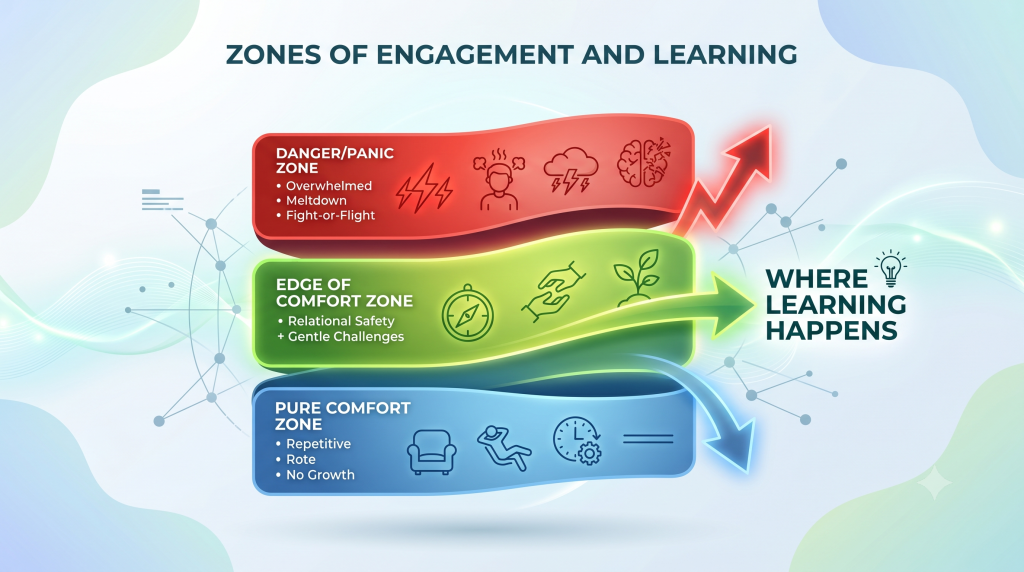
If a child loves to spin objects, bounce, or run, the adult does not stop the behavior or demand they sit at a table. Instead, the adult enters that exact sensory space—the comfort zone—and inserts a gentle challenge there. If the child wants to be tossed in the air, they are highly motivated. The adult can pause mid-motion, waiting for a gesture, a glance, or a word before completing the toss.
Because the challenge takes place within an activity the child actively “wants” to do, the brain remains highly motivated and emotionally invested. If the challenge is too difficult, the child crosses into the panic zone, triggering a defensive state. If it is too easy, they remain stuck in a rut. Gentle, relational expansions expand the boundaries of what the child can tolerate and process.
4. The Neuroscience Behind Challenging and Expanding
The principles of Greenspan Floortime are heavily validated by modern neurodevelopmental science. According to numerous neuroscience research studies referenced on stanleygreenspan.com, the human brain requires specific conditions to form permanent, highly integrated neural networks:
Shunning the “Death Spiral” of Learning
A recent study from Northwestern University highlighted what happens when children rely entirely on positive reinforcement loops. When a behavior is repeatedly rewarded externally, the brain carves a deep, efficient neural “groove.” While the child becomes highly proficient at that one specific response, the brain becomes structurally rigid. When the environment changes, the brain defaults to its automated groove and struggles to adapt.
Greenspan Floortime uses spontaneous, unpredictable circles of communication to break this “death spiral.” By constantly introducing slight variations (expanding) and playful disruptions (challenging), the child’s prefrontal cortex remains active, strengthening the hardware needed for real-world adaptability.
Neurons That Fire Together, Wire Together
When a child communicates during Floortime, they aren’t just practicing isolated speech sounds. They are integrating multiple parts of the brain simultaneously:
- Auditory processing to decode the adult’s warm tone.
- Visual processing to interpret shifting facial expressions and gestures.
- Motor planning to formulate a physical or vocal response.
- Affect/Emotion, which serves as the conductor linking these systems together.
If a child practices skills in isolation (such as sitting in front of a computer screen or drilling flashcards), “neurons that fire apart wire apart.” They may master a skill in a vacuum but fail to generalize it in a dynamic social world. Challenging and expanding ensure that skills are built across a 3-dimensional, emotionally charged social landscape, making the resulting neural pathways deep, flexible, and permanent.
5. Practical Integration into Everyday Life (ADLs)
Challenging and expanding should not be confined to a therapy room; they are meant to be woven into the fabric of daily life through Activities of Daily Living (ADLs). Routines like meal times, bath time, and getting dressed are naturally ripe with opportunities to build independence through shared interaction.
- Making a Snack: Instead of serving a snack perfectly prepared, put a desired item in a clear, tough-to-open container. Wait expectantly for the child to initiate communication. Introduce tiny logistical breakdowns, like “forgetting” a spoon, and warmly say, “Oops! Look, we have yogurt but no spoon. What should we do?” This forces the child to think, problem-solve, and interact to resolve the dilemma.
- Dressing: Instead of doing all the work, hold out a shirt backward or playfully try to place a sock on the child’s hand. This silly error creates an interactive friction. The child might laugh, push your hand away, or correct you—thereby opening and closing multiple circles of communication.
By treating protests, preferences, and mistakes as valid building blocks, caregivers help children move away from prompt-dependency and step toward genuine, self-determined independence.
Conclusion
The heart of the Greenspan Floortime Approach® lies in respect—respect for the child’s neurodivergence, their sensory needs, and their unique emotional profile. However, respecting a child does not mean leaving them isolated in a repetitive, unchallenging environment.
By meeting children entirely within their world and utilizing strategic, affectionate challenging and expanding, we provide them with the emotional safety net required to take risks. We shift the thinking back to the child, sparking internal motivation, fostering deep neurological integration, and empowering them to become the flexible, creative thinkers of their own lives.
References and Supporting Research
- Greenspan, S. I. (2023). What Is the Difference Between Greenspan Floortime and DIR/Floortime? Retrieved from stanleygreenspan.com.
- Greenspan, J. (2024). Learning and Our Comfort Zone: Growing Through Gentle Challenge. Retrieved from stanleygreenspan.com.
- Stanley I. Greenspan MD Inc. (2026). The “Death Spiral” of Learning: Why Positive Reinforcement Alone May Be Holding Children Back. [Refencing research from Northwestern University on cognitive flexibility and reinforcement loops]. Retrieved from stanleygreenspan.com.
- Greenspan, J. (2023). “Who’s Doing the Thinking?” A Key Question in Greenspan Floortime. Retrieved from stanleygreenspan.com.
- LeDoux, J. [As cited in Learning and Our Comfort Zone, stanleygreenspan.com]. Research on the neurological impacts of stress, the sympathetic vs. parasympathetic nervous systems, and their direct relationship to long-term memory and learning retention.
- Stanley I. Greenspan MD Inc. (2016). The Science of Floortime. [Discussing the neurological principles of active exploration, high emotional involvement, and the multi-system integration of neural networks]. Retrieved from stanleygreenspan.com.
- Stanley I. Greenspan MD Inc. (2026). Why ADLs Aren’t “Just Skills”—They’re Developmental Opportunities. Retrieved from stanleygreenspan.com.