
Key Takeaways
• Pathological Demand Avoidance (PDA) is a behavioral profile, not a formal DSM-5-TR or ICD-11 diagnosis.
• Under the surface, PDA reflects a nervous system that cannot sustain shared problem solving under emotional load.
• In the Greenspan Floortime® framework, this maps to a breakdown at Milestone 4 (Continuous Flow of Interaction and Shared Social Problem Solving).
• Three biological drivers converge: Intolerance of Uncertainty, atypical interoception, and autonomic shifting under Polyvagal Theory.
• Pure demand reduction protects the child in the short term but caps developmental growth.
• Pure behavioral reinforcement often entrenches rigidity through overlearned habit loops.
• The Greenspan Floortime Approach® builds flexibility through co-regulation, following the child’s lead, and shared problem solving.
A parent stands at the front door holding a pair of shoes. It is time to leave for an appointment. The parent says softly, “Put your shoes on, sweetie.”
In a fraction of a second, the room changes. The child freezes, screams, drops to the floor, or lashes out verbally: “No! You can’t make me! I hate you!” To an outside observer, this looks like defiance, manipulation, or willful non-compliance. In the clinical world, when this pattern becomes chronic, extreme, and impervious to traditional parenting, it is increasingly labeled Pathological Demand Avoidance (PDA) or Pervasive Demand Avoidance.
What is Pathological Demand Avoidance (PDA)?
Pathological Demand Avoidance, also called Pervasive Demand Avoidance, is a parent-reported behavioral profile in which a child resists ordinary everyday expectations, uses sophisticated social diversion strategies, shows rapid mood shifts, retreats into fantasy, and intensely controls relationships. PDA is not a formal diagnosis in the DSM-5-TR or ICD-11.
The standard behavioral prescription for this child is well-rehearsed: either implement firmer operant consequences; charts, praise, point systems, loss of privileges, or, if leaning into the newer PDA literature, drastically lower all demands to keep the peace.
Both approaches fail the child in the long run.
The behavioral frame is descriptively rich but mechanistically empty. It treats the refusal as an isolated behavioral target to be shaped or managed, completely missing the neurological and developmental architecture underneath. When we look beneath the surface, pulling together affective neuroscience, attachment research, psychodynamic theory, and Dr. Stanley Greenspan’s developmental framework, a very different truth emerges:
What the behavioral camp calls “demand avoidance” is not a willful refusal to comply. It is a nervous system unable to sustain shared, back-and-forth problem-solving under an emotional load. It is a breakdown at Milestone 4 (Shared Problem Solving and the Continuous Flow of Interaction), rooted in the child’s unique sensory and emotional processing.
──────────────────────────────────────────────────
1. The Behavioral Illusion: Why Descriptive Profiles Are Not Explanations
In both the DSM-5-TR and ICD-11, PDA does not exist as a formal diagnostic entity. Instead, it has circulated primarily as a parent-reported behavioral profile, frequently conceptualized as a sub-type of autism.
A 2024 scoping review by Haire and colleagues revealed a glaring void: across more than twenty years of PDA publications, there is almost no dedicated neuroimaging or neuroscience exploring what is actually happening in the brain. The literature relies nearly exclusively on rating scales like the EDA-Q and EDA-8, clinical descriptions, and borrowed theories of anxiety. Critical autism scholars, such as Richard Woods (2020), have argued that the label pathologizes a distress-driven state, confusing threat or ’survival’ responses with a character flaw or disorder.
Behavioral models document what these children do:
They resist ordinary, everyday demands.
They employ sophisticated social diversion or distraction strategies.
They experience rapid mood fluctuations.
They escape into fantasy or pretend role-play.
They become intensely focused on controlling relationships.
But describing the peak of an iceberg doesn’t explain the forces moving beneath the water. Behaviorism stops at the visible action. Dr. Greenspan taught that behavior is the final common pathway, the visible output of internal processing, emotional signaling, and developmental ability. To understand the explosion over a pair of shoes, we must travel upstream into the nervous system.
──────────────────────────────────────────────────
2. The Upstream Biology: Neuroscience of Threat, Uncertainty, and Interoception
When an adult issues a simple request, why does a child’s nervous system register an existential threat? Three biological mechanisms, working together, help explain it.
Intolerance of Uncertainty (IU) as a Threat Generator
A demand is rarely just a physical task; it is an abrupt disruption of the child’s internal state, a profound prediction-error event. In children with high Intolerance of Uncertainty (IU), central to most children with autism and childhood anxiety, any unexpected transition fires an immediate threat response.
Neuroimaging demonstrates that uncertainty hyper-activates the amygdala and the bed nucleus of the stria terminalis (BNST). When anticipation of something uncertain occurs, survival threat surges, our prefrontal executive regulation is knocked offline. The child does not think, weigh options, or evaluate consequences. The sudden command feels as catastrophic as a physical predator entering the room.
The Broken Dashboard: Atypical Interoception
To navigate external expectations, a child must first know what is happening inside their own body. Interoception, the brain’s sensing of physiological signals from the heart, gut, muscles, and respiratory system, processed primarily in the anterior insula and anterior cingulate, serves as the internal dashboard.
Research by Garfinkel et al. (2016) and Palser et al. (2018) shows that autistic and highly anxious children frequently present with severe interoceptive discrepancies. They do not perceive low-level physiological changes; they do not feel the gradual mounting of muscle tension, the creeping fatigue, the mild hunger, or sensory overload. They only register the signal when it reaches a boiling point.
If a child’s internal dashboard gives no early warnings, an adult’s sudden demand arrives when the child is already operating at redline. The explosive “NO!” is not simply defiance; it is a defensive reflex against neurological ‘overload’.
Autonomic Shifting and Neuroception
Under Stephen Porges’s Polyvagal Theory, the nervous system continuously scans the environment for safety or danger through neuroception, a rapid, subconscious physiological detection process.
When safety is detected, the child rests in the ventral vagal state (social engagement, receptive listening, spontaneous connection). But when an unexpected demand triggers a threat neuroception, the autonomic nervous system instantly shifts into sympathetic arousal (fight/flight, manifesting as defiance, rage, bolting, or aggressive resistance) or collapses into a dorsal vagal state (shutting down, immobility, mutism, or “can’t do it” lethargy).
A child cannot negotiate rationally from a sympathetic fight-or-flight state. Before higher-order reasoning can engage, the nervous system requires an external anchor of safety, a co-regulating human presence.
──────────────────────────────────────────────────
3. The Relational and Psychodynamic Reality: Beyond False-Self Compliance
Why do operant compliance strategies, stickers, timers, star charts, consequence ladders, backfire so badly with these children?
Seeking A Sense of Control and A Sense of Self
The British psychoanalyst Donald Winnicott identified that healthy emotional vitality depends on the child’s ability to express their spontaneous gesture. When a child’s spontaneous impulses are met with attunement from a “good-enough” caregiver, the child discovers their True Self, the bedrock of genuine agency, authenticity, and authentic desire.
If the environment continually overrides the spontaneous gesture with demands for compliance, the child faces an intolerable developmental choice: surrender their authentic self to keep the peace, building a compliant, hollowed-out False Self, or fight for psychic survival.
Seen through Winnicott, the child displaying “pathological demand avoidance” is a child fiercely protecting the integrity of their True Self. They refuse to surrender to a rigid compliance and trying to protect their authentic agency. The problem is not their desire to hold their agency; the problem is that their environment has not provided a developmental framework that allows their True Self to feel safe and connected at the same time.
4. Dr. Greenspan’s Framework: Milestone 4 and The Learning Tree
What is Milestone 4 in the Greenspan Floortime Approach?
Milestone 4, the Continuous Flow of Interaction and Shared Social Problem Solving, is the Functional Emotional Developmental capacity to open and close continuous back and forth circles of communication to navigate shared intentions and solve shared problems. It typically emerges between 9 and 18 months and is the engine of social flexibility.
What is the Greenspan Floortime Approach®?
The Greenspan Floortime Approach® is Dr. Stanley Greenspan’s version of the DIR/Floortime model. It uses attuned, affect based, child led interaction to help children climb a hierarchy of Functional Emotional Developmental Milestones, building the capacity for regulation, engagement, communication, shared problem solving, symbolic thinking, and logical reasoning.
Dr. Stanley Greenspan provided the clinical and developmental framework that ties biology and psychodynamics together. Rather than viewing development as isolated, fragmented skills, Greenspan organized human emotional and cognitive growth into hierarchical Functional Emotional Developmental Milestones:
Milestone 1: Self-Regulation and Shared Attention (Calm, organized, interested in the world)
Milestone 2: Engagement and Relating (Warmth, falling in love, mutual trust)
Milestone 3: Two-Way Purposeful Communication (Opening and closing simple circles of communication)
Milestone 4: Continuious Flow of Interaction and Shared Social Problem Solving (Opening and closing continuous, interconnected circles of communication to navigate intentions and solve shared problems)
Milestone 5: Meaningful Symbolic Ideas (Symbolic play, expressive language, mental representations)
Milestone 6: Emotional and Logical Thinking (Connecting ideas, understanding cause and effect, building bridges between feelings and reality)
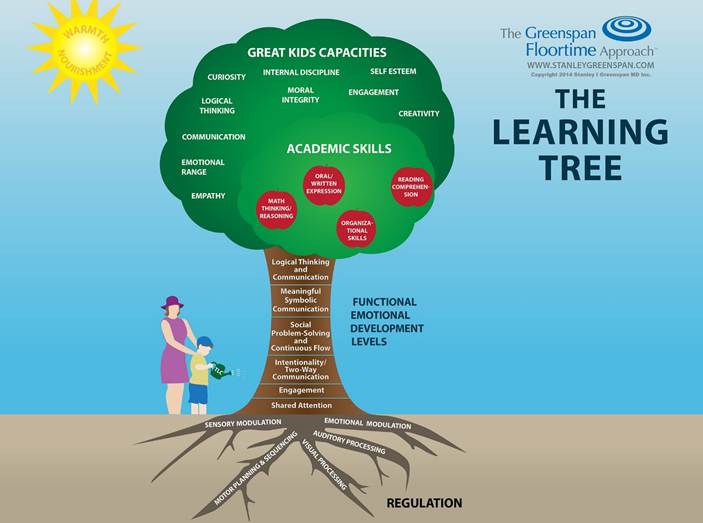
The Metaphor of the Tree
Think of a child’s development as an apple tree:
The Root System represents Individual Differences: The child’s sensory processing (auditory, visual, tactile, vestibular, proprioceptive, and interoceptive profiles), their motor planning (praxis), and their autonomic baseline.
The Trunk represents the Early Milestones (1, 2, and 3) The capacity to stay calm, maintain shared attention, stay warmly connected with a partner, and pass back-and-forth emotional gestures. (4, 5 and 6) Complex social negotiation, emotional ideas, and reasoned, flexible thinking.
The Branches represent the Great Kids Emotional Outcomes- Higher Milestones (7, 8, and 9): The reflective milestones.
When a child exhibits the rigid, oppositional, or avoidant behaviors labeled PDA, behaviorists fixate on the ‘diseased branches’. They attempt to paint the leaves green or trim them away with token economies and compliance drills. But the wilted leaf is not the disease; it is the distress signal of a system out of balance.
Why “PDA” Is a Breakdown at Milestone 4
Milestone 4 (Continuous Flow of Interaction and Shared Social Problem Solving, typically emerging between 9 and 18 months) is the engine of human social flexibility. It requires a child to coordinate multiple back-and-forth circles of communication in a continuous dynamic/adaptive interaction.
In Milestone 4, a child who wants a toy that is out of reach doesn’t just scream; they take their parent by the hand, walk them across the room, point up, look back at the parent’s face to see if they understand, gesture urgently, and respond as the parent asks, “Is it the truck or the blocks?” They open and close twenty, thirty, or forty circles of communication to navigate a shared obstacle or game.
Shared problem-solving requires an enormous amount of neurological bandwidth:
The child must remain biologically regulated (Milestone 1).
The child must feel safe, warm, and invested in the relationship (Milestone 2).
The child must have fluid, reciprocal two-way signaling (Milestone 3).
If a child arrives at Milestone 4 with a fragile foundation, hypersensitive hearing, poor motor planning, a lack of body and/or spatial awareness, etc., their foundational budget is nearly depleted just staying upright.
Under the emotional load of an adult’s expectation, the child’s nervous system cannot support a 30-circle back and forth negotiation. The system collapses back into a single, protective, repetitive loop: “NO. GO AWAY. NEVER.”
That single-circle protective loop, viewed through a traditional behavioral lens, looks like pathological defiance. Viewed through Greenspan’s model, it is a developmental system unable to maintain Milestone 4 under stress.
──────────────────────────────────────────────────
5. Decoding the PDA Profile Through Greenspan’s Lens
Behavioral Observation in “PDA” Developmental & Psychodynamic Reality
Resists ordinary everyday demands Milestone 1 regulation budget is depleted; unexpected demands present as prediction-error threats to an unstable nervous system.
Uses sophisticated social avoidance Milestone 3 signaling is functional enough to deflect, but Milestone 4 capacity is insufficient to co-create an alternative solution with the adult.
Rapid mood swings / sudden meltdowns Autonomic state shifts (ventral vagal dropping into sympathetic fight/flight or dorsal freeze), not willful manipulation or deceit.
Overly Rigid/Concrete View of the World Lacking the abstract reasoning needed to navigate a world going through constant change, the child maintains rigid views of concepts.
Excessive immersion in role-play / fantasy Stepping outside the high-demand physical reality into symbolic safety where the child controls all outcomes.
Controlling relationships or obsessive focus on adults Attempting to manage intense internal uncertainty; hyper-recruiting the attachment figure to manufacture external stability.
──────────────────────────────────────────────────
6. Beyond Demand Reduction: Building True Neuropotential
In current PDA discourse, parents are often advised that the only “respectful” or humane path is radical demand avoidance; eliminate demands, drop all boundaries, keep the peace.
While acute demand reduction can provide vital triage for an exhausted, traumatized nervous system, demand avoidance is not a developmental destination. Leaving a child permanently inside an environment devoid of expectations respects their current neurodivergence, but it abandons their neuropotential.
Respecting neurodivergence cannot mean enshrining habitual, self-protective, or isolating behaviors forever. The developing brain is extraordinarily plastic (including children with ASD or PDA) longitudinal neuroimaging and behavioral research shows that experience-dependent neural change continues robustly through childhood and adolescence, and that a child’s capacity for cognitive and emotional flexibility is shaped by the challenges a supportive environment helps them meet (Kolb & Gibb, 2011; Tooley, Bassett, & Mackey, 2021). When we completely eliminate demands without building foundational capacities, the child’s world shrinks to an ever-smaller perimeter of rigid control, we accommodate the symptom at the cost of the developmental trajectory.
Nor can we rely on operant conditioning to force them forward.
The Rigidity Trap of Pure Reinforcement
Therapists and educators often counter demand resistance with intensive behavioral reinforcement: reward charts, behavioral praise, and token systems. Yet decades of cognitive neuroscience explain why this often exacerbates rigidity rather than easing it. Two converging bodies of research work on habit formation in the basal ganglia (Graybiel, 2008; Yin & Knowlton, 2006) and predictive-processing accounts of autistic cognition (Pellicano & Burr, 2012; Van de Cruys et al., 2014) describe what can be called a rigidity trap.
When a child is repeatedly reinforced for producing a single pre-determined behavioral output, the brain (dorsal striatum) consolidates that response into a fixed habit, efficient, automatic, and resistant to revision (Graybiel, 2008). The child gets hyper-efficient at performing that specific prompted response, but loses the capacity to adapt when novelty, friction, or unexpected change arrives. Predictive-processing research adds a second layer: a nervous system already struggling to weight uncertainty will cling even harder to the narrow, overlearned pattern, because deviation from the trained response registers as prediction error, i.e., threat (Van de Cruys et al., 2014).
Positive reinforcement alone trains rigid, adult-dependent habit loops. When real life introduces unpredictable circumstances, the child’s brittle exterior cracks, producing the very meltdowns clinicians were trying to “treat”.
The Clinical Road: Expanding the Child’s Thinking Through Greenspan Floortime®
The goal of development is to help a child build the internal capacity to bend without breaking; to experience novelty, challenge, and limits without collapsing into sympathetic panic. We do not achieve this by commanding compliance or by running away from demands. We achieve it by meeting the child on their developmental ground and climbing the social-emotional milestone ladder together.
Step 1: Secure Milestones 1, 2, and 3 Through Attuned Co-Regulation
Before addressing a task or demand, assess the child’s autonomic state. You cannot teach problem-solving to a brain trapped in a sympathetic fight-or-flight firestorm.
Tone down the sensory environment (accommodating their regulatory profile; sensory and emotional)
Offer a calm, unhurried, emotionally receptive physical presence.
Match their affect and establish warm, shared attention. Safety is the prerequisite for all cortical learning.
Step 2: Follow the Child’s Lead to Protect the True Self
In Greenspan Floortime®, we start by following the child’s lead. Joining their organic interest validates their Winnicottian spontaneous gesture, assuring them that their agency is intact. When the adult willingly enters the child’s world rather than imposing an external agenda, threat neuroception diminishes, and the ‘defenses’ begin to soften.
Step 3: Open and Close Continuous Circles of Communication
Once inside the child’s interest, we do not simply observe; we invite back-and-forth interaction.
If a child is lining up cars, we don’t demand they stop. We gently roll a car into their line.
When they look up, pause, or push it aside, a circle of communication has opened and closed.
We respond to their gesture with another warm, attuned gesture.
By continuously stringing together these reciprocal exchanges, we build the neural infrastructure of Milestone 3 and Milestone 4. Every circle of communication trains the brain to anticipate, process social-emotional cues, and adapt to novelty in real time.
Step 4: Cultivate Shared Problem-Solving (Milestone 4)
Real resilience is built when we introduce playful friction inside a secure activity, game, or environment.
When the shoes must go on, it is not delivered as a top-down ultimatum backed by reward or punishment. Nor is it abandoned.
It is framed as an interactive, shared challenge: “Oh no, the shoe is stuck on my head! How are we going to get this out the door? Can you pull? Should the left shoe drive the car, or the right one?”
We invite the child to co-construct the solution, opening and closing dozens of circles around the hurdle.
By engaging in shared problem-solving, the child is not performing compliance; they are exercising active psychological agency. They learn that two people can hold differing desires, navigate an obstacle, and remain connected without either party being destroyed.
──────────────────────────────────────────────────
Nourishing the Root System
A child labeled with PDA is not a child with a defective character, an incurable oppositional drive, or an innate allergy to everyday life. They are children whose unique biological Individual Differences have made the foundational milestones fragile, causing their developmental capacity to fracture at Milestone 4 whenever emotional demands rise.
When we discard the narrow lenses of behavioral management, we stop fighting symptoms on the surface. We turn our attention to the roots. By honoring their sensory and emotional differences, offering steady co-regulation, and climbing the functional emotional milestones together through Greenspan Floortime®, we help their nervous systems discover that connection is not a trap. In that discovery, rigidity softens, defiance transforms into authentic collaboration, and the child’s true neuropotential begins to bloom.
──────────────────────────────────────────────────
Frequently Asked Questions About PDA and the Greenspan Floortime Approach
Is Pathological Demand Avoidance a formal diagnosis?
No. Pathological Demand Avoidance (PDA) is not a formal diagnostic category in the DSM-5-TR or ICD-11. It circulates as a parent-reported behavioral profile that is often conceptualized as a sub-type of autism.
How is PDA different from typical oppositional behavior?
PDA involves chronic, extreme, nervous system driven avoidance of ordinary expectations, paired with sophisticated social diversion, rapid mood shifts, fantasy retreat, and intense control of relationships. It is not strategic defiance; it is a stress response in a system unable to sustain shared problem solving.
What does the Greenspan Floortime Approach say about PDA?
In the Greenspan Floortime® framework, PDA behaviors reflect a breakdown at Milestone 4, the Continuous Flow of Interaction and Shared Social Problem Solving. The child’s foundational capacities (regulation, engagement, two-way signaling) are fragile, so emotional demands overwhelm the system and collapse it into a single protective loop.
Does the Greenspan Floortime Approach use demand reduction?
Acute demand reduction can help an overwhelmed child stabilize. It is a triage tool, not a destination. The Greenspan Floortime Approach® uses attuned co-regulation and shared problem solving to build the child’s long term capacity for flexibility, so the child can meet real world challenges without collapsing.
Why do reward charts and token systems often fail with PDA profiles?
Habit formation research (Graybiel, 2008) and predictive processing research (Van de Cruys et al., 2014) show that repeated reinforcement of a single response consolidates rigid, adult dependent habit loops in the dorsal striatum. For a child already struggling with uncertainty, any deviation from the trained response registers as prediction error, which the nervous system reads as threat.
How does the Greenspan Floortime Approach help a child with PDA features?
By first establishing autonomic safety through attuned co-regulation, then following the child’s lead to protect the True Self, then opening and closing continuous circles of communication, and finally introducing playful friction so the child co-constructs solutions. This builds Milestone 4 capacity from the inside out.
References
Garfinkel, S. N., Tiley, C., O’Keeffe, S., Harrison, N. A., Seth, A. K., & Critchley, H. D. (2016). Discrepancies between dimensions of interoception in autism: Implications for emotion and anxiety. Biological Psychology, 114, 117–126. https://www.sciencedirect.com/science/article/pii/S0301051115300302
Graybiel, A. M. (2008). Habits, rituals, and the evaluative brain. Annual Review of Neuroscience, 31, 359–387. https://pubmed.ncbi.nlm.nih.gov/18558860/
Grupe, D. W., & Nitschke, J. B. (2013). Uncertainty and anticipation in anxiety: An integrated neurobiological and psychological perspective. Nature Reviews Neuroscience, 14(7), 488–501. https://www.nature.com/articles/nrn3524
Haire, E., Davis, R., Clark, S., Allen, K., & Pellicano, E. (2024). Pathological demand avoidance in children and young people: A scoping review. Review Journal of Autism and Developmental Disorders. https://pmc.ncbi.nlm.nih.gov/articles/PMC11067416/
Herrington, J. D., Maddox, B. B., Kerns, C. M., Rump, K., Worley, J. A., Bush, J. C., McVey, A. J., Schultz, R. T., & Miller, J. S. (2017). Amygdala volume differences in autism spectrum disorder are related to anxiety. Social Cognitive and Affective Neuroscience, 12(6), 907–916. https://academic.oup.com/scan/article/12/6/907/3074643
Kolb, B., & Gibb, R. (2011). Brain plasticity and behaviour in the developing brain. Journal of the Canadian Academy of Child and Adolescent Psychiatry, 20(4), 265–276. https://pmc.ncbi.nlm.nih.gov/articles/PMC3222570/
Palser, E. R., Fotopoulou, A., & Kilner, J. M. (2018). Altering movement parameters disrupts metacognitive accuracy. Consciousness and Cognition, 57, 33–40. https://www.frontiersin.org/articles/10.3389/fnhum.2018.00225/full
Pellicano, E., & Burr, D. (2012). When the world becomes ‘too real’: A Bayesian explanation of autistic perception. Trends in Cognitive Sciences, 16(10), 504–510. https://pubmed.ncbi.nlm.nih.gov/22959875/
Porges, S. W. (2007). The polyvagal perspective. Biological Psychology, 74(2), 116–143. https://www.sciencedirect.com/science/article/pii/S0301051106001530
Porges, S. W. (2022). Polyvagal theory: A science of safety. Frontiers in Integrative Neuroscience, 16, 871227. https://www.frontiersin.org/articles/10.3389/fnint.2022.871227/full
Tooley, U. A., Bassett, D. S., & Mackey, A. P. (2021). Environmental influences on the pace of brain development. Nature Reviews Neuroscience, 22(6), 372–384. https://pubmed.ncbi.nlm.nih.gov/33911229/
Van de Cruys, S., Evers, K., Van der Hallen, R., Van Eylen, L., Boets, B., de-Wit, L., & Wagemans, J. (2014). Precise minds in uncertain worlds: Predictive coding in autism. Psychological Review, 121(4), 649–675. https://pubmed.ncbi.nlm.nih.gov/25347312/
Winnicott, D. W. (1960). Ego distortion in terms of true and false self. In The Maturational Processes and the Facilitating Environment (pp. 140–152). International Universities Press. https://icpla.edu/wp-content/uploads/2013/03/Winnicott-D.-Ego-Distortion-in-Terms-of-True-and-False-Self.pdf
Woods, R. (2020). Pathological demand avoidance and the DSM-5: A rebuttal. Developmental Medicine & Child Neurology, 62(8), 977. https://pubmed.ncbi.nlm.nih.gov/32394732/
Yin, H. H., & Knowlton, B. J. (2006). The role of the basal ganglia in habit formation. Nature Reviews Neuroscience, 7(6), 464–476. https://www.nature.com/articles/nrn1919
“`json { “@context”: “https://schema.org”, “@graph”: [ { “@type”: “MedicalWebPage”, “@id”: “https://stanleygreenspan.com/pda-greenspan-floortime-milestone-4/#webpage”, “url”: “https://stanleygreenspan.com/pda-greenspan-floortime-milestone-4/”, “name”: “PDA and Greenspan Floortime: Why Demand Avoidance Happens”, “description”: “Pathological Demand Avoidance is not willful defiance. Learn how the Greenspan Floortime Approach reframes PDA as a Milestone 4 breakdown you can heal.”, “inLanguage”: “en-US”, “isPartOf”: { “@id”: “https://stanleygreenspan.com/#website” }, “about”: [ { “@type”: “Thing”, “name”: “Pathological Demand Avoidance” }, { “@type”: “Thing”, “name”: “The Greenspan Floortime Approach” }, { “@type”: “Thing”, “name”: “Functional Emotional Developmental Milestones” }, { “@type”: “Thing”, “name”: “Autism Spectrum Disorder” } ], “audience”: { “@type”: “MedicalAudience”, “audienceType”: “Parents, caregivers, clinicians, educators” }, “specialty”: “Developmental and Behavioral Pediatrics”, “lastReviewed”: “2026-11-16”, “reviewedBy”: { “@type”: “Organization”, “name”: “Stanley I Greenspan MD Inc” } }, { “@type”: “Article”, “@id”: “https://stanleygreenspan.com/pda-greenspan-floortime-milestone-4/#article”, “headline”: “Beyond the Demand: Understanding Rigidity, Defiance, and PDA Through Greenspan’s Developmental Milestones”, “alternativeHeadline”: “A Greenspan Floortime view of Pathological Demand Avoidance”, “image”: “https://stanleygreenspan.com/wp-content/uploads/2026/11/pda-greenspan-floortime-milestone-4-hero.jpg”, “datePublished”: “2026-11-16”, “dateModified”: “2026-11-16”, “author”: { “@type”: “Organization”, “name”: “Stanley I Greenspan MD Inc”, “url”: “https://stanleygreenspan.com/” }, “publisher”: { “@type”: “Organization”, “name”: “Stanley I Greenspan MD Inc”, “logo”: { “@type”: “ImageObject”, “url”: “https://stanleygreenspan.com/wp-content/uploads/greenspan-floortime-approach-logo.png” } }, “mainEntityOfPage”: { “@id”: “https://stanleygreenspan.com/pda-greenspan-floortime-milestone-4/#webpage” }, “articleSection”: “The Greenspan Floortime Approach”, “keywords”: “PDA, Pathological Demand Avoidance, Greenspan Floortime, Milestone 4, shared problem solving, DIR model, autism, demand avoidance, Stanley Greenspan, Polyvagal Theory, interoception” }, { “@type”: “BreadcrumbList”, “@id”: “https://stanleygreenspan.com/pda-greenspan-floortime-milestone-4/#breadcrumbs”, “itemListElement”: [ { “@type”: “ListItem”, “position”: 1, “name”: “Home”, “item”: “https://stanleygreenspan.com/” }, { “@type”: “ListItem”, “position”: 2, “name”: “Articles”, “item”: “https://stanleygreenspan.com/articles/” }, { “@type”: “ListItem”, “position”: 3, “name”: “PDA and Greenspan Floortime” } ] }, { “@type”: “FAQPage”, “@id”: “https://stanleygreenspan.com/pda-greenspan-floortime-milestone-4/#faq”, “mainEntity”: [ { “@type”: “Question”, “name”: “Is Pathological Demand Avoidance a formal diagnosis?”, “acceptedAnswer”: { “@type”: “Answer”, “text”: “No. Pathological Demand Avoidance (PDA) is not a formal diagnostic category in the DSM-5-TR or ICD-11. It circulates as a parent-reported behavioral profile that is often conceptualized as a sub-type of autism.” } }, { “@type”: “Question”, “name”: “How is PDA different from typical oppositional behavior?”, “acceptedAnswer”: { “@type”: “Answer”, “text”: “PDA involves chronic, extreme, nervous system driven avoidance of ordinary expectations, paired with sophisticated social diversion, rapid mood shifts, fantasy retreat, and intense control of relationships. It is not strategic defiance; it is a stress response in a system unable to sustain shared problem solving.” } }, { “@type”: “Question”, “name”: “What does the Greenspan Floortime Approach say about PDA?”, “acceptedAnswer”: { “@type”: “Answer”, “text”: “In the Greenspan Floortime framework, PDA behaviors reflect a breakdown at Milestone 4, Complex Communication and Shared Problem Solving. The child’s foundational capacities are fragile, so emotional demands overwhelm the system and collapse it into a single protective loop.” } }, { “@type”: “Question”, “name”: “Does the Greenspan Floortime Approach use demand reduction?”, “acceptedAnswer”: { “@type”: “Answer”, “text”: “Acute demand reduction can help an overwhelmed child stabilize. It is a triage tool, not a destination. The Greenspan Floortime Approach uses attuned co-regulation and shared problem solving to build long term capacity for flexibility.” } }, { “@type”: “Question”, “name”: “Why do reward charts and token systems often fail with PDA profiles?”, “acceptedAnswer”: { “@type”: “Answer”, “text”: “Habit formation research and predictive processing research show that repeated reinforcement of a single response consolidates rigid, adult dependent habit loops. For a child already struggling with uncertainty, any deviation from the trained response registers as prediction error, which the nervous system reads as threat.” } }, { “@type”: “Question”, “name”: “How does the Greenspan Floortime Approach help a child with PDA features?”, “acceptedAnswer”: { “@type”: “Answer”, “text”: “By first establishing autonomic safety through attuned co-regulation, then following the child’s lead to protect the True Self, then opening and closing continuous circles of communication, and finally introducing playful friction so the child co-constructs solutions. This builds Milestone 4 capacity from the inside out.” } } ] } ] } “`